How an AI Engineer Transformed their Global Talent Application
The breakthrough came through evidence restructuring, criteria optimization, and reference letter rewrites.

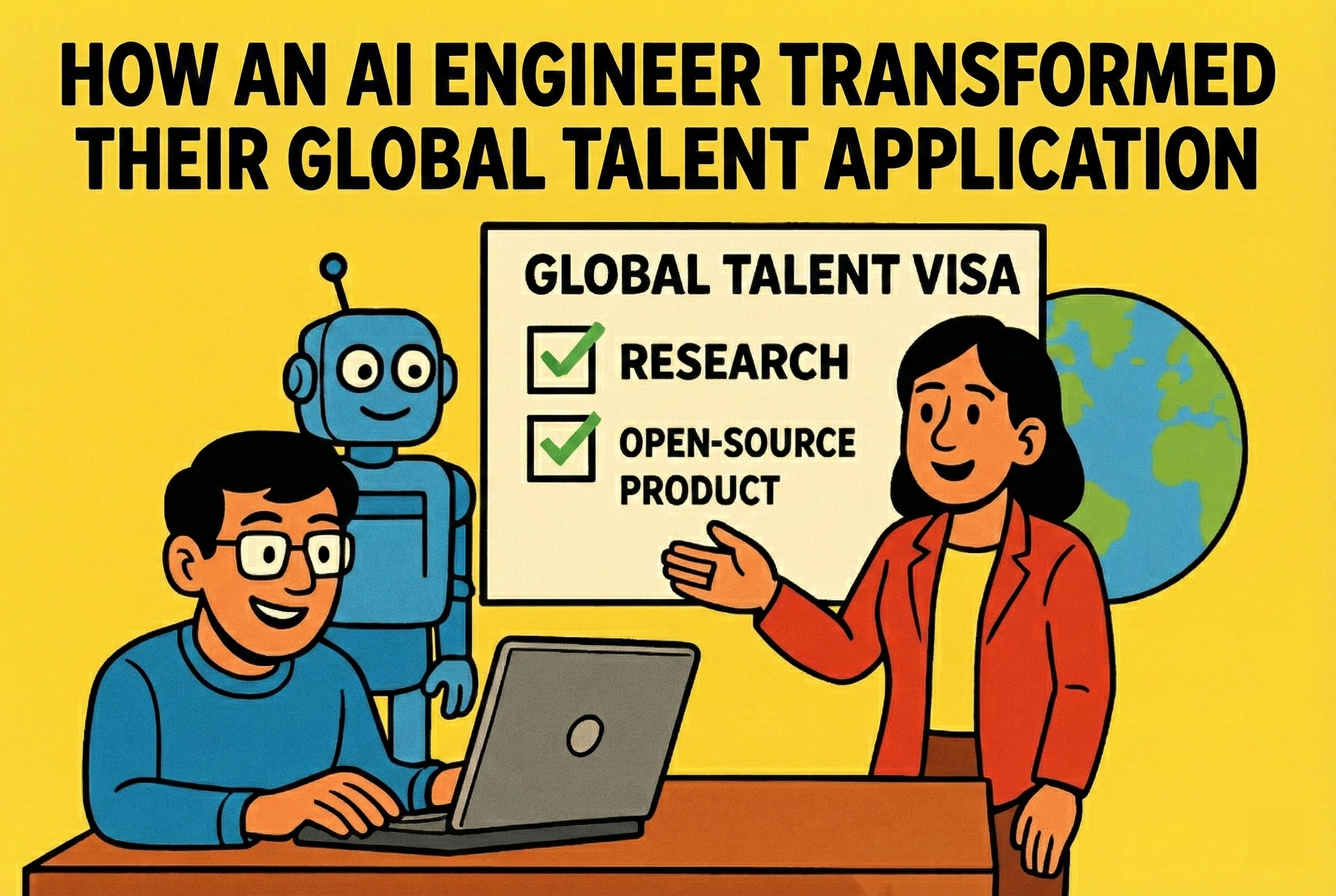
The Global Talent Visa opens career freedom for technical professionals. Work anywhere, switch jobs, or start businesses without employer sponsorship. This case study follows a mid-career AI engineer whose application reveals specific approaches for positioning technical contributions across research, open-source work, and commercial product development. The initial approach used generic templates and scattered documentation that needed restructuring.
The breakthrough came through evidence restructuring, criteria optimization, and reference letter rewrites. The application became a narrative of exceptional promise backed by verifiable innovation and commercial impact.
Self Documentation Makes Assessors' Jobs Easier
Every evidence package opened with a "zero page". This self-documentation page explained what the evidence demonstrated, why it mattered, and how it connected to exceptional talent criteria. This approach transformed assessment from detective work into guided reading. Assessors could immediately understand the innovation without hunting through PDFs or making inferences. The technique worked across all criteria submissions, turning each piece of evidence into a self-contained story rather than raw documentation.
Create a "Zero Page" Explaining Each Evidence
The zero page sat at the front of every evidence submission. It stated clearly what the evidence demonstrated. The page then listed specific evidence items below this statement. Actual evidence pages started from page two onward. This structure meant assessors understood the claim before seeing documentation, rather than piecing together what dozens of PDFs were supposed to prove.
Name Documents to Match Committee Expectations
Every file name followed committee conventions precisely. Letters of Support were labeled "Letter of Reference" in the filename. MC evidence files specified "MC Evidence" in their titles. OC submissions clearly indicated which optional criterion they addressed. This eliminated confusion when assessors reviewed hundreds of files across multiple applications. The naming system let committee members instantly identify document types without opening files or reading headers.
Bundle Multiple Proofs into Single Strong Evidence
Rather than submitting three separate weak evidences, the application combined related materials into one comprehensive package. Academic work bundled a published research paper, conference reviewer invitation, and exceptional GPA into a single MC submission. This created one strong evidence of academic excellence rather than three borderline submissions. The bundling approach recognized that aggregated proofs demonstrate broader impact than scattered individual achievements.
Building Side Projects That Matter
The dataset generated 3,000+ downloads on a popular data platform, spawned a research subgroup, and was cited in multiple PhD theses. This demonstrated that side project impact extends far beyond initial publication. The key was choosing a problem that mattered to practitioners and researchers alike, then documenting it thoroughly enough for others to build upon. Rather than positioning this as hobby work, the application framed it as field contribution that advanced research capabilities. This showed how open-source work that gains traction becomes evidence of technical leadership and community influence.
Document Downstream Impact
The application tracked how others built upon the work. The dataset spawned its own research subgroup focused on the specific problem domain. Multiple PhD students cited it in their theses as foundational data for their research. One researcher published papers using the dataset as their primary data source. These downstream effects proved the contribution mattered beyond personal achievement. The evidence included screenshots of citations, links to derivative research, and examples of how practitioners used the data to solve real problems.
Track Quantifiable Metrics (Downloads, Forks)
Every claim came with numbers. The dataset showed 3,000+ downloads from the platform. Code notebooks demonstrated 1,000+ forks from other developers. GitHub repositories displayed star counts and contribution graphs. These metrics provided objective proof that couldn't be dismissed as self-promotion. The application included proper print-screens from platforms rather than simple screenshots. Each metric was contextualized with industry benchmarks showing what typical projects achieve versus the outsized impact demonstrated.
Combine Multiple Platforms for "Significant Contributor" Proof
Rather than treating the data platform and GitHub as separate contributions, the application bundled them into one OC2 submission targeting "significant contributor to open source projects." This combined approach showed consistent pattern of field contribution across platforms. The package demonstrated more than isolated work publication but maintained active presence in open source community. This bundling turned two moderate evidences into one strong proof of sustained technical leadership.
The First Hire Advantage
Being the first technical hire at a company provides exceptional evidence that generic engineering roles cannot match. You build the foundation rather than extend existing systems. The position enabled architecting a data analysis platform from scratch that generated £1M+ projected annual revenue and was adopted by four major distribution system operators. The application emphasized foundational ownership. The applicant made architectural decisions, chose technology stacks, and built systems that became company infrastructure. This positioning worked because it showed technical leadership through building rather than through managing people.
Emphasize Building Foundation vs. Extending Existing Systems
The application distinguished between foundational work and incremental development. As first tech hire, the applicant chose the technology stack, designed system architecture, and made decisions that every future engineer would inherit. The reference letter from the CEO detailed how the applicant built initial technologies and product demos when nothing existed. This contrasted sharply with typical engineering roles where you extend existing codebases following established patterns. The evidence included system design diagrams showing the full architecture created.
Quantify Financial Impact (£1M+ Revenue Projections)
Every technical contribution connected to business value. The triangulation system generated projected annual revenue exceeding £1M. The application didn't just claim "built a successful product." It provided specific financial figures the CEO could verify. The reference letter explained how technical decisions enabled the company to enter new markets and secure enterprise clients. This financial quantification transformed the evidence from "good engineer" to "technical work that drives substantial commercial outcomes."
Document Industry Adoption (4 Major DSOs Using Tool)
Beyond revenue, the application demonstrated that major industry players adopted the work. Four distribution system operators used the triangulation tool. The evidence showed these weren't small pilot projects but production deployments at scale. This industry adoption proved the technical innovation solved real problems for sophisticated users. The reference letter named these organizations and explained how the system became industry infrastructure rather than an internal tool.
Template Elimination and Letter Authenticity
Assessors are cautious about templated reference letters. The application needed complete rewrites removing all AI-generated phrasing, bold headings, and formulaic structures. Each letter was rebuilt around one question: why was this person's contribution technically innovative? Rather than listing job responsibilities or using generic praise, the letters focused on specific technical challenges. The revision process involved stripping template language, then reconstructing letters as natural narratives that explained specific technical challenges, innovative solutions, and measurable impact. This meant letters from different referees maintained distinct voices while telling complementary parts of the same story.
Remove Bold Headings and AI-Generated Phrasing
Original letters came with section headers in bold, bullet points listing achievements, and AI-generated phrases. Every template marker was stripped out. The revised letters read as natural text without formatting tricks. Phrases that sounded like AI generation got replaced with specific technical descriptions. Instead of "excels at machine learning," letters explained particular algorithms implemented and why they mattered. This made letters sound like genuine professional assessments rather than form letters.
Rewrite All Letters to Remove Jargon
Because assessors are typically non-technical, every letter was rewritten for accessibility. Technical depth remained but jargon was minimized. When explaining the data analysis system, letters described the business problem it solved before diving into implementation details. One well-written letter became the template for rewriting others. Not making them identical but ensuring consistent tone and clarity. This uniformity helped assessors follow the narrative across three different letter writers without getting lost in varying technical depth or writing quality.
Never Use Immediate Colleagues as Letter Writers
This rule eliminated the lead engineer despite years of close collaboration. Tech Nation guidelines exclude immediate colleagues and managers as referees. The final selection included an academic professor from the research work, the CEO of the startup, and an industry expert from outside the immediate team. This meant finding referees who knew the work well enough to write detailed letters but weren't disqualified by daily working relationships. The application avoided any referee whose relationship could be challenged as too close or hierarchical.
Conclusion
For AI and machine learning professionals specifically, several lessons emerge. Technical contributions across research, commercial, and open-source domains can strengthen rather than dilute applications when positioned properly. Quantitative metrics like download counts, user numbers, revenue impact, and citation counts provide crucial objective evidence that complements qualitative innovation claims. Technical depth must be balanced with accessibility, ensuring non-specialist assessors understand why contributions matter.
For engineers considering Global Talent applications, the path to success involves evidence curation that emphasizes strongest contributions rather than comprehensive documentation, reference letters that explain technical innovation rather than list responsibilities, quantitative metrics that demonstrate impact objectively, and authentic UK value propositions based on specific industry or research contributions rather than generic opportunity statements.
Need specialized guidance with your Global Talent Visa application? Book some time with me at Topmate.