The 3-Part Evidence Structure That Gets Global Talent Applications Approved

You've spent weeks gathering your evidence. You have the screenshots, the metrics, the reference letters. You upload everything, hit submit, and wait eight weeks — only to read "the applicant has not provided sufficient evidence" in your rejection proforma.
Having reviewed dozens of Global Talent Visa applications — successful and rejected — I've found that the single biggest differentiator isn't what evidence you have. It's how you present it within each document. The applications that get endorsed consistently follow a three-part structure on every single piece of evidence. The ones that get rejected consistently don't.
Here's the structure, and why each part matters.
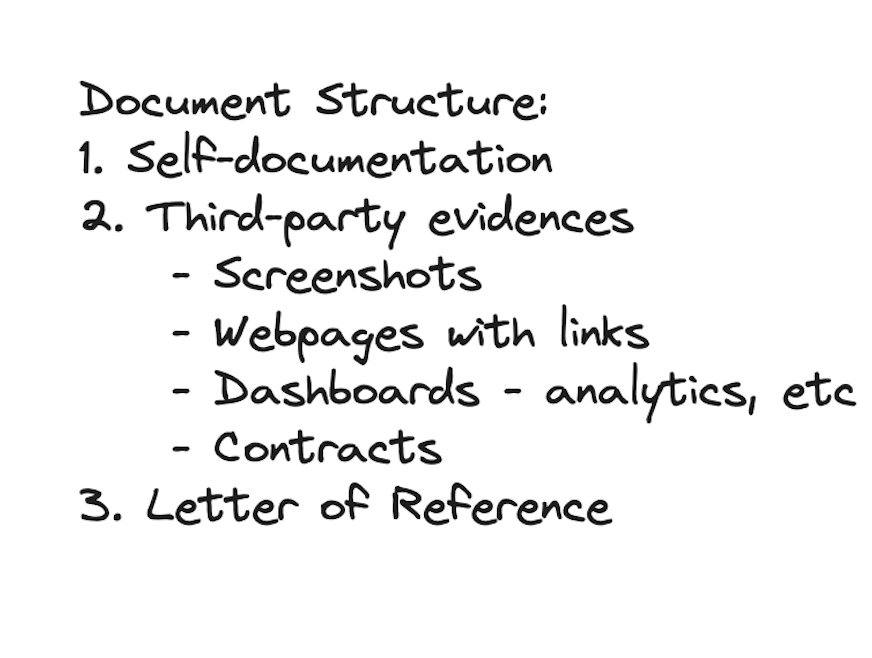
Part 1: Self-Documentation
The first page of every evidence document is yours. This is where you explain, in your own words, what the evidence is, what you did, and why it matters.
Think of this as your opening argument. The assessor has never met you. They don't know your company, your product, or your industry. They are reviewing hundreds of applications, and they need to understand your contribution within seconds of opening each document.
Your self-documentation should answer three questions: what was the context, what specifically did you do (not your team — you), and what was the measurable outcome. If you led a product redesign that increased conversion by 40%, say that in the first two sentences. If you were invited to speak at a conference because the organiser saw your work featured on national television, explain that chain of events clearly.
Keep it to one page. This is critical. If your self-documentation bleeds onto page two, you're eating into the space you need for proof. Trim aggressively. Remove anything that doesn't directly explain the evidence or connect it to the criterion you're claiming.
Write in layman's terms. Assessors are not engineers. If you write "implemented a microservices architecture using Kubernetes orchestration to reduce deployment latency," they won't know whether that's impressive or routine. Instead, write "redesigned the company's software infrastructure so that new features could be released to customers in minutes instead of days, directly enabling a 30% increase in customer retention." The second version tells a non-technical reader exactly why your work mattered.
One more thing: state which criterion this evidence addresses. Name it explicitly — "This evidence supports Mandatory Criteria, example 2" — so the assessor doesn't have to guess.
Part 2: Third-Party Evidence
Page two is where you prove what page one claimed. Third-party evidence includes screenshots of analytics dashboards showing the growth you described, webpages where your name appears as a speaker or contributor, contracts or official letters confirming your role, press articles covering your product or company, award certificates, programme acceptance emails, or published material featuring your work.
The key principle is that this evidence must be verifiable and external. Internal Slack messages don't count. A congratulatory email from your manager doesn't count. What counts is anything an assessor could, in theory, verify independently: a Google Analytics screenshot showing 200,000 monthly users, a conference website listing you as a keynote speaker, a newspaper article describing your company's impact, or a government programme's official acceptance letter.
Format matters here. Each screenshot or image should take the full width of the page, arranged vertically — never side by side. Tech Nation counts each image as a separate page, and collage-style layouts where you've squeezed four screenshots onto one page will cause your evidence to exceed the three-page limit and risk outright rejection. One image per row. Full width. Clear and readable.
Never use Google Drive links, YouTube links, or any external URLs as your evidence. Assessors will not follow them. Everything must be embedded directly in the PDF. If you're referencing a webpage, take a screenshot of it. If you're referencing a video, screenshot the title card with view count and embed that instead.
Part 3: Letter of Reference
The third part is a letter of reference specific to that piece of evidence. Not one of your three main recommendation letters — a supplementary letter from someone who can directly corroborate what you've claimed on pages one and two.
If your evidence is about a conference talk, the letter should come from the conference organiser explaining why you were specifically invited to speak. If your evidence is about a product you built, the letter should come from a customer or partner describing the impact of that product on their business. If your evidence is about a mentorship programme, the letter should come from the programme coordinator confirming your selection, your role, and the outcomes.
This is the part most applicants skip entirely, and it's the part that separates approved applications from rejected ones. Without it, your evidence is a claim backed by a screenshot. With it, your evidence is a claim backed by a screenshot and an independent person vouching for its authenticity.
It should be signed, ideally via DocuSign which generates a verification trail showing when and where the document was signed. The author's name should appear at the top, and the letter should reference the Global Talent Visa by name.
Putting It Into Practice
For each of your ten evidence documents, structure them like this:
- Page 1 — Your self-documentation. One page maximum. Explain the evidence, your personal role, the measurable outcome, and which criterion it supports. Write in plain English.
- Page 2 — Third-party proof. Screenshots, dashboards, contracts, webpages, press coverage. Full-width images, vertically stacked, no collages.
- Page 3+ — A specific letter of reference from someone who can independently verify the claims you made on page one.
Name each file clearly: "Evidence 1 MC", "Evidence 5 OC2". Organise them into folders by criterion. Make the assessor's job as easy as possible.
Every successful application I've reviewed follows this pattern. Every rejection I've analysed is missing at least one of the three parts. The evidence itself matters, of course — but the structure is what makes the evidence legible, credible, and convincing.
Need help structuring your Global Talent Visa application? Book a session and I'll review your evidence documents against these patterns.